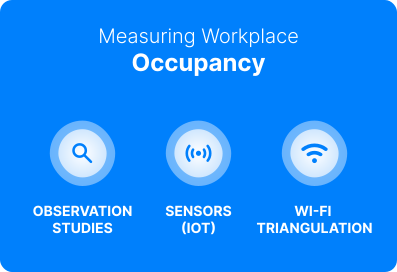
As hybrid work continues to reshape the workplace, organizations are increasingly trying to understand how their offices are actually being used. Occupancy measurement has become one of the most discussed topics in workplace strategy, real estate, and facility management, but not all occupancy data is created equal.
Measuring whether a desk or room is occupied at a given moment is only part of the picture. The more important question is often why spaces are being used the way they are, what behaviours are taking place, and whether the workplace is effectively supporting organizational performance.
Today, organizations use several different methods to measure workplace occupancy, each with its own strengths, limitations, costs, and level of insight.
1. Observation Studies
Observation studies remain one of the oldest — and still one of the most effective — workplace measurement methods. In this approach, trained observers walk through the workplace at scheduled intervals and manually record how spaces are being used.
This can include:
- Desk occupancy
- Meeting room usage
- Collaboration patterns
- Types of work activities
- Team interactions
- Space suitability
- Behavioural observations
- Environmental observations
Unlike purely quantitative technologies, observation studies provide context. For example, a sensor may indicate that a meeting room is occupied, but an observer can identify whether the room is being used for focused work, collaboration, social interaction, or whether the space is overcrowded or underutilized.
Advantages
- Rich behavioural insights
- No hardware installation required
- Low implementation cost
- Fast deployment across multiple sites
- Minimal IT involvement
- More privacy-friendly than many sensor-based approaches
Limitations
- Not real-time
- Requires manual labour
- Typically conducted periodically rather than continuously
However, for many organizations, continuous real-time occupancy tracking is not actually necessary for strategic workplace decisions.
2. Wi-Fi Deep Sensing
Wi-Fi deep sensing uses radio frequency signals from enterprise Wi-Fi infrastructure to detect human presence and movement. Rather than relying only on connected devices, the technology analyzes disruptions and reflections in Wi-Fi signals caused by human bodies moving through space.
This newer category of sensing can potentially identify:
- Presence
- Motion
- Density
- Movement patterns
- Breathing patterns
- In some advanced use cases, even heart rate and micro-movements
Because the technology can often leverage existing enterprise Wi-Fi infrastructure, deployment costs are becoming significantly lower than traditional large-scale sensor installations. As the technology matures, it is increasingly being explored as a scalable and relatively cost-effective alternative to dedicated occupancy hardware.
Advantages
- No cameras required
- Can leverage existing Wi-Fi infrastructure
- Lower hardware costs compared to many IoT deployments
- Passive sensing approach
- Can provide near real-time insights
- Broad area coverage with minimal additional hardware
Limitations
- Still relatively emerging in workplace applications
- Accuracy varies by environment and building layout
- Requires calibration and signal optimization
- Limited behavioural context
- Privacy and perception concerns may still arise depending on implementation
While promising, Wi-Fi deep sensing still primarily measures presence and movement rather than workplace intent, collaboration quality, or behavioural effectiveness.
3. Wi-Fi Triangulation
Wi-Fi triangulation estimates occupancy by tracking connected devices such as smartphones and laptops through access point signals. By measuring signal strength across multiple access points, organizations can estimate where people are located within the office.
This method became popular because many organizations already operate enterprise Wi-Fi networks.
Advantages
- Uses existing infrastructure
- Can provide continuous occupancy trends
- Useful for portfolio-level utilization analytics
- Scalable across large office environments
Limitations
- Depends on users carrying connected devices
- One person may carry multiple devices
- Some people may carry no devices at all
- Accuracy can vary significantly
- Limited room-level precision in some environments
- Provides limited behavioural insight
Wi-Fi triangulation is generally more useful for identifying macro-level occupancy trends than for making detailed workplace strategy decisions.
4. Bluetooth Beacon Technologies
Some organizations also use Bluetooth beacon technologies for indoor positioning and occupancy analytics. In these setups, mobile devices interact with installed beacons to estimate proximity and movement patterns within the workplace.
Beacon systems are often used for:
- Indoor navigation
- Employee wayfinding
- Location-based workplace services
- Occupancy estimation
Advantages
- Relatively low-cost hardware
- Useful for indoor positioning
- Can support workplace mobile applications
- Flexible deployment
Limitations
- Often requires mobile app adoption
- Accuracy depends on device interaction
- Requires hardware installation and maintenance
- Limited behavioural insight
- Scalability challenges across large portfolios
While useful for certain workplace experiences, beacon technologies are generally less effective as standalone occupancy measurement solutions.
5. IoT Occupancy Sensors
IoT occupancy sensors are among the most widely adopted workplace measurement technologies today. These can include:
- Desk sensors
- Motion sensors
- Infrared sensors
- Thermal sensors
- People-counting devices
- Environmental sensors
They are typically installed throughout the workplace to continuously monitor occupancy and utilization.
Advantages
- Real-time occupancy data
- High granularity
- Automated collection
- Useful for operational workflows such as cleaning and room release
Limitations
- Hardware installation costs
- Ongoing maintenance and battery replacement
- IT and cybersecurity requirements
- Sensor failures and calibration issues
- Limited understanding of workplace behaviour
- Can become expensive at scale
For organizations focused primarily on strategic workplace insights rather than operational automation, the cost-to-value ratio can sometimes be difficult to justify.
6. CCTV and Computer Vision
Computer vision systems use cameras combined with AI models to estimate occupancy, movement, and spatial behaviour.
These systems can provide:
- Footfall analytics
- Density heatmaps
- Queue analysis
- Collaboration mapping
- Movement tracking
- Space utilization analytics
Advantages
- High accuracy
- Detailed movement analytics
- Real-time visibility
- Useful for complex environments
Limitations
- Significant privacy concerns
- Legal and compliance considerations
- Higher implementation complexity
- Expensive infrastructure and AI processing
- Potential employee trust implications
In workplace environments, privacy and employee perception often become major barriers to adoption.
7. Workspace Reservation Data
Workspace reservation platforms provide another important layer of workplace insight. Desk booking and meeting room reservation systems generate data about intended workplace usage patterns.
This data can reveal:
- Demand trends
- Peak attendance days
- Team coordination behaviour
- Preferred zones and neighbourhoods
- Meeting room demand
However, reservation data should not be treated as actual occupancy data. A booked desk does not necessarily mean someone attended the office, and many employees still use spaces without formally reserving them.
Advantages
- Already available in many workplaces
- Useful for demand forecasting
- Strong operational value
- Helps understand planned behaviour
Limitations
- Measures intent rather than actual usage
- Often incomplete or inaccurate
- Cannot capture unbooked activity
- Limited behavioural context
Reservation data works best when combined with other occupancy measurement methods.
So Which Method Is Best?
The right occupancy measurement method ultimately depends on the goal.
If the objective is:
- operational automation
- live space availability
- cleaning optimization
- or real-time building management
then sensors or Wi-Fi-based systems may be appropriate.
But if the goal is workplace strategy, understanding how people work, collaborate, interact with spaces, and whether the workplace is effectively supporting organizational performance — then observation studies remain one of the most effective approaches available.
Observation studies provide something that many technologies still struggle to capture: behavioural context.
They are also:
- significantly cheaper
- easier to deploy
- less invasive
- and do not require hardware installation or complex integrations
Most importantly, continuous real-time occupancy monitoring is often unnecessary for strategic workplace decisions. Workplace patterns generally stabilize over time, meaning organizations can gain highly reliable insights through periodic measurement rather than permanent monitoring.
In many cases, conducting a well-designed two-week observation study every six months is more than sufficient to:
- identify utilization trends
- understand behavioural patterns
- validate workplace changes
- support major real estate decisions
At the same time, one of the biggest challenges organizations face today is not the lack of occupancy data, but the fragmentation of workplace data across multiple systems and technologies. Different organizations may use observation studies, Wi-Fi analytics, IoT sensors, reservation platforms, and employee experience surveys simultaneously, yet these datasets are rarely connected into a single decision-making framework.
Workplaced unifies workplace data from multiple sources into a single workplace decision intelligence system.
This allows organizations to analyze occupancy, behavioural, employee experience, and workplace performance data together within the same environment, regardless of how the data was originally collected.
Ultimately, the future of workplace measurement is likely not about choosing a single occupancy method, but about integrating multiple data sources into a unified understanding of workplace performance and organizational outcomes. The value of occupancy measurement is not determined by how much data is collected, but by how effectively that data supports better workplace decisions.