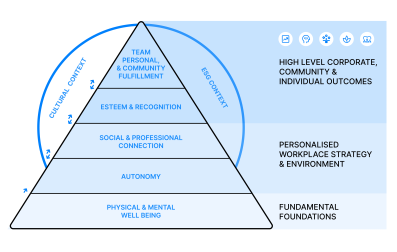
Abraham Maslow's (1943) hierarchy of human needs has profoundly influenced the behavioural sciences, becoming a seminal concept in understanding human motivation.
It is noteworthy that Maslow probably did not actually create the iconic pyramid that is frequently associated with his hierarchy of needs. Researchers believe it was popularised instead by psychologist Charles McDermid, who was inspired by a step-shaped model designed by management theorist Keith Davis.
Additionally, there is a lot of recent discussion around the time Maslow spent with the Blackfoot Reserve amongst the Siksika indigenous people, and an alternative circular view of the model captures the inter-relatedness of our needs and helps highlight that we can experience needs simultaneously and in changing order, something we explore in the paper. It also sets the foundations for a broader view of self and communal actualisation.
Maslow's hierarchy of needs provides a framework for understanding human motivation, suggesting that individuals must meet lower-level physiological and safety needs before progressing to higher-level psychological and self-fulfilment needs. The paper interprets what those needs mean in a workplace context, and what follows for how a workplace is designed and operated.