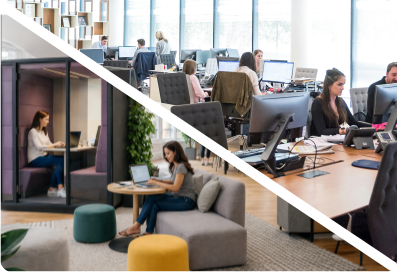
For more a while now, the open office has been applied to workplace design. It promised collaboration, transparency, and cost efficiency. But as organisations mature in their hybrid strategies and employees demand environments that genuinely support how they work, the conversation has shifted. Leaders are now asking a more nuanced question: Is the open office still fit for purpose or is Activity‑Based Working (ABW) the smarter path forward?
Workplace strategists see the same pattern across sectors: the most successful environments aren't defined by aesthetics, but by behavioural insight, operational clarity, and a design strategy that aligns with real work patterns and business objectives. So let's break down the two models and explore what actually works:
What Is an Open Office, Really?
The open office is often misunderstood as "one big room with desks". In reality, it should be a single‑mode environment built around shared visibility and proximity. Its strengths lie in:
- High desk density
- Low fit out cost
- Easy reconfiguration
- A sense of energy and buzz
But it also comes with well‑documented challenges:
- Noise and distraction
- Limited privacy
- Poor support for focus work
- "One‑size‑fits‑none" experience
Open offices work best when the work itself is collaborative, fast‑paced, and interdependent – think sales floors, creative studios, or early‑stage start‑ups.
What Is Activity‑Based Working?
Activity‑Based Working is not a furniture trend. It's a behaviour‑led operating model that gives people a choice of settings based on the task at hand. A well‑designed ABW environment typically includes:
- Focus rooms
- Collaboration zones
- Project spaces
- Social hubs
- Quiet libraries
- Touchdown points
- Hybrid‑ready meeting rooms
The goal is simple: match the environment to the activity.
When implemented properly, ABW delivers:
- Higher productivity
- Better employee autonomy
- Stronger cross‑team connection
- More efficient use of space
- A workplace that adapts as the organisation evolves
But ABW only succeeds when supported by:
- Clear behavioural protocols
- Change management
- Leadership modelling
- Digital tools that enable mobility
Without these, ABW can quickly become chaotic, confusing, and under‑utilised.
Which Model Performs Better?
Here's the truth: neither model is universally "better". The right choice depends on your organisation's culture, work patterns, and strategic goals.
Open Office Works Best When
- Work is highly collaborative and synchronous
- Teams benefit from constant visibility
- Speed outweighs privacy
- The organisation is small or early‑stage
- Cost efficiency is a priority
ABW Works Best When
- Work varies across focus, collaboration, and hybrid modes
- Teams need autonomy and flexibility
- The organisation is scaling or diversifying
- Employee experience is a strategic priority
- Hybrid work is embedded
Most mid‑size and large organisations now find ABW more aligned with modern work patterns, especially as hybrid becomes the norm, but works best when there's trust and everyone buys in.
What We See in Real Organisations
Across our workplace strategy projects, a few themes consistently emerge:
- Focus work is still the most underserved need.
Even in collaborative cultures, people need quiet, controlled environments to deliver work and connect virtually, especially in this hybrid world.
- Hybrid work has made "assigned desks for everyone" obsolete.
Utilisation data rarely justifies a traditional open office layout where everyone has ownership. You must be driven by metrics other than cost to justify this.
- People value choice, but only when it's intuitive.
ABW fails when spaces are poorly labelled, poorly located, or poorly governed. People also need reminding on the protocols to prevent old behaviours.
- Culture determines success more than furniture.
The best workplace strategies are co‑designed with teams, backed up by real meaningful data, not imposed on them.
So… What Should You Choose?
If you're designing a workplace for now and beyond, here's the strategic lens we recommend:
- Start with behaviours, not layouts.
Work out how your people actually work and what they need to be productive and comfortable – not how you assume they work.
- Design for flexibility, not trends.
Your workplace should evolve as your organisation evolves. Why wait until your next lease end to tweak things – keep on top of the changes before the workplace becomes unsupportive.
- Prioritise ergonomic and psychological safety.
People do their best work when they feel in control of their environment and feel comfortable.
- Support hybrid as a default, not an exception.
Spaces must be designed for seamless digital‑physical collaboration. Even if you're asking people to come in 5 days per week, most of our work is online.
- Measure, iterate, and refine.
Workplace strategy is a living system, not a one‑off project. Keep it relevant, keep tracking data.
The Bottom Line
The open office isn't dead, but it's no longer the default. Activity‑Based Working offers a more adaptive, human‑centred approach that aligns with the realities of hybrid work and the expectations of modern talent.
The organisations winning today are the ones treating workplace strategy as a business tool, not a design exercise. They build environments that support focus, collaboration, wellbeing, and culture, because they know the workplace is not just where work happens, but where identity, belonging, and performance are shaped.