Book a demo

Occupancy

Space utilisation measurement

Measure and optimize space utilization

Facilities teams are asked to defend every square metre. Occupancy shows when and how desks, meeting rooms and other spaces are used; with observation studies, also for which activities. Choose observation, sensors or Wi-Fi, and choose who carries out the study.

Who is it for?

Workplace, Corporate Real Estate and Facilities teams looking to understand how space is actually being used.

  • Workplace
  • Corporate Real Estate
  • Facilities

What is it for?

Challenges it solves

  • Low visibility into actual space utilization
  • Inefficient allocation of desks, rooms and support spaces
  • Underused or overcrowded areas
  • Difficulty planning hybrid and flexible work environments
  • Lack of reliable data to support real estate decisions
  • Difficulty identifying high- and low-performing spaces
  • Inconsistent occupancy data across locations or floors

When to use it

  • Planning a new office or relocation
  • Redesigning or renovating an existing workplace
  • Introducing or reviewing hybrid and flexible work policies
  • Growing, downsizing or consolidating office space
  • Reducing real estate and facilities costs
  • Preparing for a lease renewal or expansion
  • Reviewing team layouts or departmental adjacencies
  • Supporting sustainability or ESG reporting

Playing loads the video from YouTube.

Office Occupancy & Space Utilization Measurement | Workplaced Measure office occupancy, space utilization, and workplace activity with Workplaced. Understand how desks, meeting rooms, and other spaces are used to identify underutilized areas and make data-driven workplace and real estate decisions.

Case study

~$1.2M in annual expansion costs avoided

Proving the existing workplace had enough capacity

1,200-person technology company

Challenge
The company was preparing to lease additional office space to support future growth.
What we found
Occupancy data showed how much of the existing workplace was actually being used and revealed sufficient spare capacity to accommodate the projected workforce.
Impact
The organization avoided the planned expansion, saving approximately $1.2M per year in additional real estate costs.

Key features

  • Flexible Measurement Methods

    Use observation studies, IoT sensors or Wi-Fi triangulation independently or in combination, with hardware-agnostic sensor integration and support for major Wi-Fi networks.

  • Custom Space Types & Categories

    Define the spaces, zones and categories you want to measure and compare.

  • Occupancy & Utilization Analytics

    Understand how spaces are occupied and actually used across different times, days and measurement periods.

  • Real-Time Occupancy MonitoringIoT & Wi-Fi

    Monitor occupancy and utilization automatically through sensors or existing Wi-Fi infrastructure.

  • Space Type Performance

    Compare desks, meeting rooms, offices and support spaces to understand how each performs.

  • Capacity & Demand Analysis

    Identify where space is over-provided, underused or experiencing too much demand.

  • Floorplan Heatmaps

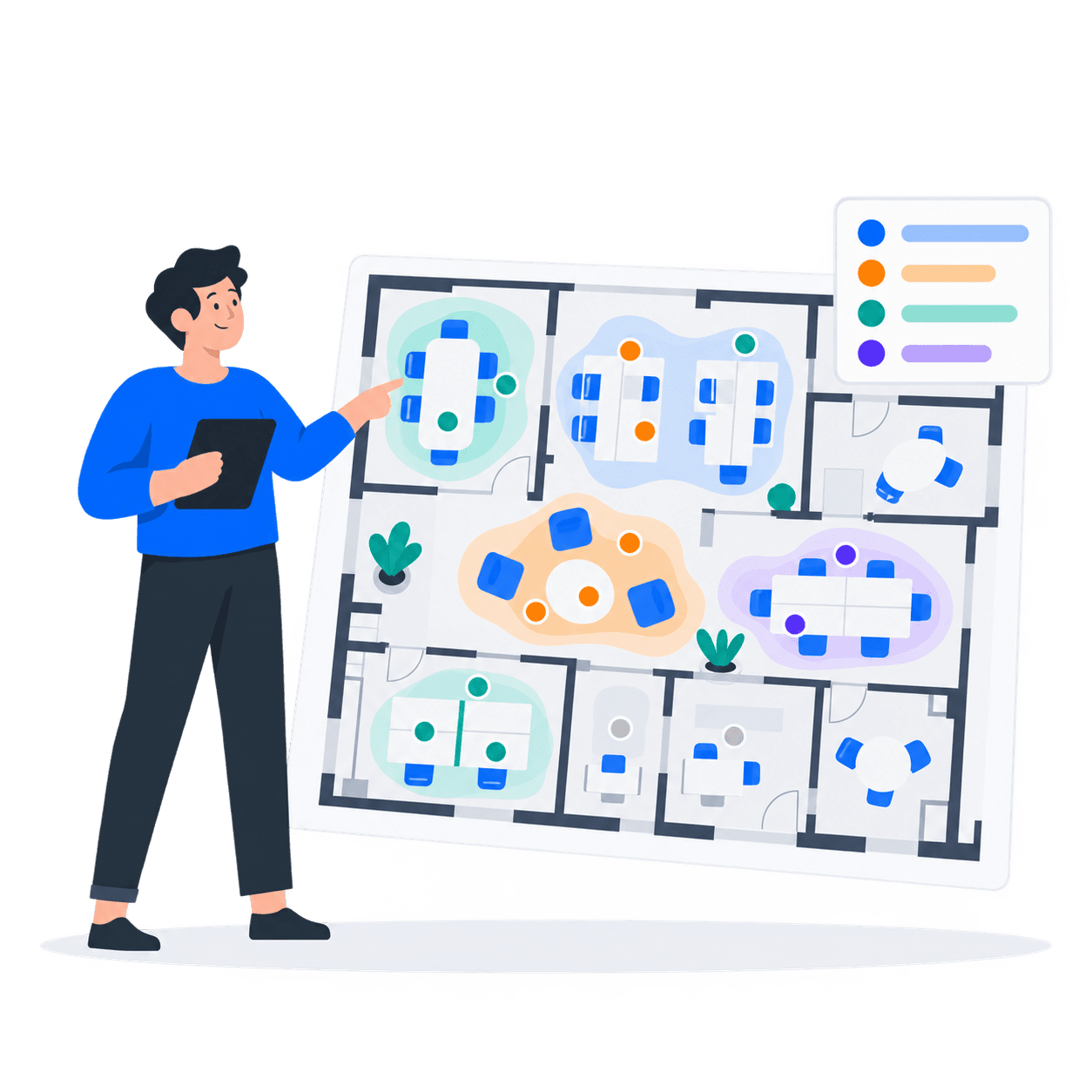
    Visualize occupancy and utilization directly across your workplace layout.

  • Activity MappingObservation only

    Understand what people are actually doing in each space, including focus work, meetings and collaboration.

  • Occupancy & Experience CorrelationObservation only

    Connect observed space-use patterns with how employees experience the workplace.

  • Guided Observation StudiesObservation only

    Use generated walking routes and in-app guidance to keep measurement sessions consistent.

  • On-Site SurveysObservation only

    Capture employee feedback alongside observed space use during measurement sessions.

  • AI-Powered Reporting

    Automatically turn occupancy data into reports and decision-ready insights.
FAQs

  • What is Occupancy?

    Occupancy measures how workplace space is actually occupied and utilized.

  • How can occupancy be measured?

    Through observation studies, IoT sensors or Wi-Fi triangulation, independently or in combination.

  • What is the difference between the three methods?

    Observation studies provide deeper activity-level insight, while IoT and Wi-Fi provide automated occupancy and utilization data at scale.

  • Can the methods be combined?

    Yes. Organizations can combine methods to balance insight depth, coverage and cost.

  • Can we use our existing sensors or Wi-Fi infrastructure?

    Yes. Workplaced is hardware-agnostic for IoT sensors and supports major Wi-Fi environments.

  • What does Occupancy analyze?

    Occupancy, utilization, space-type performance, capacity, demand and usage patterns over time.

  • Can Occupancy provide real-time data?

    IoT and Wi-Fi can provide continuous or near-real-time occupancy information depending on the underlying infrastructure.

  • Can Occupancy show what people are doing in a space?

    Yes. Observation studies can capture activities such as focus work, meetings and collaboration.

  • Which capabilities require observation studies?

    Activity mapping, on-site surveys, guided observation routes and occupancy-to-experience analysis.

  • Does Occupancy support floorplan heatmaps?

    Yes. Occupancy and utilization can be visualized directly across workplace layouts.

  • Does Occupancy track individual employees?

    No. Occupancy is designed to analyze space use rather than track individuals.

  • Can Occupancy work across multiple locations?

    Yes. Results can be analyzed by floor, building, location or portfolio.

Tell us which space decision you are facing

In your request, describe the building or buildings, the period and the method you are considering. In a 45-minute conversation we discuss which method and which delivery fit your question. You receive a reply within one working day and a short written summary after the conversation.