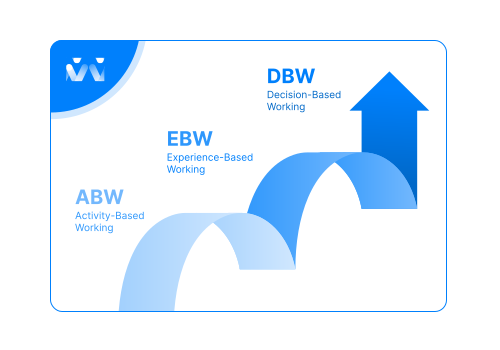
How organizations move from designing spaces to optimizing performance through decision intelligence.
Workplace strategy has evolved from Taylorist efficiency models, focusing on simplistic productivity, to open plan offices with a focus on cost and space, to, more recently, over the past two decades, two major paradigms:
- Activity-Based Working (ABW) — optimizing space for tasks and efficiency.
- Experience-Based Working (EBW) — enhancing employee experience and wellbeing.
While both have some research to underpin them, they both draw from a fragmented range of disciplines and evidence and lack thorough empirical testing and evaluation.
Both ABW and EBW have their critics and flaws, which we examine briefly. For example, the relationship between mobility and ABW and the propensity to be mobile is often underestimated, resulting in what Leesman calls a lack of productivity alignment between ABW settings and human behaviour. Research by Leesman also found that lack of choice of appropriate ABW work settings was a significant negative influence on perceived productivity.
Whilst Decision-Based Working (DBW) manages some of the criticisms of ABW and EBW, it does have its own limitations and challenges. The effectiveness of DBW is highly dependent on the quality, completeness, and integration of underlying data, which in many organizations remains fragmented or inconsistent. Organizations may face capability gaps in interpreting insights and translating them into actionable decisions, particularly where workplace, HR, and real estate functions remain siloed. There is also a risk that over-reliance on quantitative inputs may underrepresent qualitative and cultural nuances, which are critical in shaping workplace outcomes. As such, DBW is not a replacement for strategy or leadership judgement, but rather an enabler that requires strong governance, cross-functional alignment, and continuous validation.
Whilst the evolution of workplace strategies has advanced how workplaces are designed, they have not solved the most fundamental and critical of challenges: how to make informed, objective workplace decisions that balance cost, experience, and performance?