Hybrid working has been formally recognised as promoting productivity benefits, in the first major empirical study by Nicholas Bloom of Stanford University. We therefore feel it appropriate, in our first white paper, to examine how, in practice, hybrid workplace strategies can deliver employee engagement and satisfaction, efficiency of occupation and the delivery of corporate goals.
Despite this acknowledgement of hybrid performance, many organisations have recently implemented blanket return to work mandates, with questionable impacts, as reported in a study by the Katz Graduate School of Business.
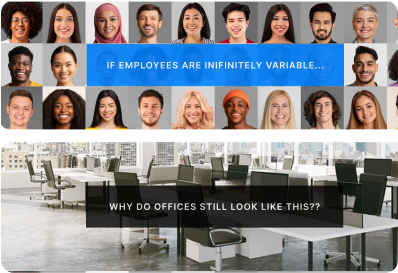
The problem is that rarely are the essential questions being asked: who needs to be in the office, why and when? Hybrid working is not a one-size-fits-all situation, which blanket mandates are predicated on. Some workers have very static, low impact and low connectivity work profiles and activities, who can safely spend more time out of the office without impacting productivity. Others must spend more time in the office to deliver the five Cs: collaboration, connection, culture, creativity and camaraderie.
But this is only part of the story. Individual psychometrics, personality and circumstances will also have an impact.
At Workplaced our logic unifies all these components to create an individual and optimised profile, what we call the hybrid balance, within the context and culture of a specific organisation. We can also provide a workplace passport to individual employees, which is transferable, for use in changing offices or circumstances.
Our first paper discusses some of the latest research in hybrid working as the context to support our human-centric and data-driven approach to formulating hybrid workplace strategies. It illustrates our unifying logic and methodology that creates workplace solutions informed by an aggregate of personal hybrid balances, which integrate data on an employee's activities, connectivity, psychometrics, sentiment and mobility within a defined organizational culture.