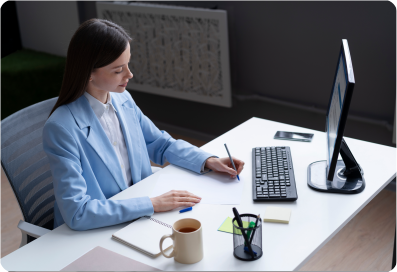
Proximity bias is a growing risk in hybrid and remote work, and without deliberate design it could undermine the flexibility the UAE is extending to women and working mothers in 2026 (Raconteur, 2023; Qualtrics & The Boardlist, 2021; Rotman School of Management, 2025). At the same time, robust evidence shows that well-designed flexible work can sustain or improve performance and retention, making it vital to align UAE visa-per-square-metre rules and office design with new hybrid realities (Bloom et al., 2015; Bloom et al., 2024; Emanuel & Harrington, 2023).
Proximity bias and women in hybrid work
Proximity bias refers to managers' tendency to favour employees they see more often in person when assessing performance, promotion and pay decisions (Raconteur, 2023). Studies of hybrid workplaces show that workers who spend more time physically near managers receive more informal feedback, better assignments and greater visibility in influential meetings, translating into superior career outcomes even when productivity is similar (Emanuel & Harrington, 2023; Raconteur, 2024).
Women are more likely than men to opt for flexible or remote options, especially when they have young children, so any penalty against remote work falls disproportionately on them (Qualtrics & The Boardlist, 2021; Raconteur, 2024). One survey of remote professionals found that men working remotely received pay increases roughly twice as often as women (26 per cent versus 13 per cent), even when both groups were equally active online (Qualtrics & The Boardlist, 2021). Deloitte's ‘Women @ Work’ research similarly reports that many hybrid women feel excluded from key discussions and worry about reduced exposure to senior leaders, patterns consistent with proximity bias (Deloitte, 2023).
At the same time, fully on-site work exposes women to other forms of gender bias. A study reported by the Rotman School of Management found that 31 per cent of women working on-site experienced gender discrimination, compared with 17 per cent of women working remotely, including their ideas being disregarded and being assigned non-promotable tasks (Rotman School of Management, 2025). This creates a trade-off: remote work can improve psychological safety, but if organisations do not explicitly manage proximity bias, it can also carry a career and pay penalty.
The UAE's 2026 push for flexibility for women
In early 2026, the UAE Federal National Council (FNC) considered proposals to formalise flexible and remote work for Emirati mothers, particularly those with children under ten, caring responsibilities for elderly parents or family members of determination (The National, 2026). The proposals include extending fully paid maternity leave in the public sector to up to 98 days for Emirati women and reinforcing the right to flexible or remote arrangements for specific categories of mothers (The National, 2026).
These moves sit within a wider policy agenda in which the UAE has expanded family-friendly provisions and signalled interest in incentives for private employers that adopt similar policies (Khaleej Times, 2025). If implemented at scale, a significant proportion of Emirati women in knowledge and administrative roles could be working in hybrid or remote patterns, amplifying both the benefits and the potential risks associated with flexibility.
Evidence that flexible work boosts performance and retention
A substantial research base now shows that hybrid and flexible work can maintain or improve performance while significantly enhancing retention and wellbeing.
A large randomised experiment at Trip.com, led by Bloom and colleagues and published in Nature, assigned some employees to work from home two days per week and compared them with those in the office five days (Bloom et al., 2024). The study found no negative effect on measured productivity or promotion rates, while attrition fell significantly among hybrid workers, indicating that hybrid arrangements can be performance-neutral but retention-positive (Bloom et al., 2024). In a separate public-sector trial, Bloom reports a productivity increase of about 12 per cent with hybrid work from home, driven by quieter conditions, alongside cost savings of around 20 per cent (Bloom, 2025).
Earlier research on a Chinese travel agency found that allowing employees to work from home increased performance by about 13–21 per cent, largely due to fewer breaks and less sick leave, and that satisfaction rose when flexible choice was opened to all employees (Bloom et al., 2015). Beyond productivity, studies of schedule flexibility for mothers show that rigid hours are associated with higher stress, greater work–family conflict and more absenteeism, which directly undermine sustained performance (Golden, 2020). Business analyses estimate that around two-thirds of women currently outside the workforce would consider returning if they had access to flexible hours, highlighting the labour-supply gains of family-friendly policies (Forbes, 2018).
For a country like the UAE, which has explicit goals around women's participation and leadership, harnessing these performance and participation gains depends on ensuring that flexibility does not come with an invisible career cost.
Designing for flexible working: experience, planning and utilisation
To make flexible working work in practice, organisations need to design both space and systems for hybrid use. Fixed desks and constant presence reinforce proximity bias and undermine flexibility. Workplaced is built to support dynamic hybrid workplaces by bringing experience, planning and space data together for intelligent decision making.
- Dynamics is the employee experience layer.
- Balance supports hybrid work planning and team coordination.
- Occupancy measures occupancy and utilisation.
- Booking provides workspace and desk reservation.
Together, these products form a connected workplace operating system, rather than disconnected point solutions. Several design principles emerge when using an integrated platform:
Hybrid space allocation
Hybrid attendance varies by team, role and day. Using Occupancy and Booking, organisations can see actual demand patterns and adapt space accordingly. Offices can shift between collaboration-led layouts and focus-work modes based on bookings, utilisation trends and predicted footfall. This supports a mix of collaboration areas, quiet zones and touchdown spaces instead of one desk per person.
Smart desk-sharing and hybrid planning
With Booking and Balance, employees can choose when and where they work, while leaders gain visibility on how space is being used. Balance supports team-based planning, including anchor days, helping teams coordinate in-office time without mandating full-time presence. Utilisation data highlights which areas are over- or under-used, allowing real estate teams to right-size space over time.
Integrated employee experience
Dynamics connects space decisions to how people actually feel at work. Floor-plan views, occupancy and visibility of who is in the office help employees plan purposeful in-office days focused on collaboration, learning and visibility. Dynamics can also signal early indicators of disengagement, giving employers advance warning of which teams or departments may be at risk when new workplace strategies are introduced.
Data-led change management
Because the products sit together, leaders can link experience data, hybrid patterns and utilisation metrics. This makes it easier to test new workplace strategies, measure impact and adjust quickly. Instead of relying on assumptions, decisions are grounded in real behaviour and sentiment.
Used this way, organisations in the UAE can move away from seat-time as a proxy for commitment. Hybrid patterns become planned rather than ad hoc, office time becomes intentional, and outcomes and collaboration take priority. This shift is critical in reducing proximity bias and supporting more inclusive workplace models, particularly for employees who spend more time working remotely.
Why UAE visa-per-square-metre rules must evolve
On the UAE mainland, employment visa allocations are still closely linked to office size, with authorities commonly applying formulas that allocate approximately one visa for every 9–10 square metres of office space (Creative Zone, 2026). Business guidance makes clear that to increase visa quotas, companies typically need to lease additional space and pass physical inspections to demonstrate that they have enough desks and facilities for their stated headcount (Dubai Company, 2025).
This model conflicts with the logic of hybrid work in several ways. It incentivises firms to maintain large, densely used offices even when a substantial share of staff could work in hybrid patterns, because reducing space can result in fewer visas regardless of business productivity (Creative Zone, 2026). It discourages footprint reduction and investment in dynamic, tech-enabled layouts enabled by hybrid-planning tools, since smaller offices may constrain future hiring (Shuraa, 2025). It also reinforces the cultural assumption that “real work” happens at a dedicated, visa-linked desk, indirectly feeding the view that remote employees are less central or promotion-worthy.
If the UAE wants the private sector to mirror government ambitions for flexible work for women, it will likely need to modernise visa-quota rules so that headcount is not rigidly tied to square metres. Options could include allowing higher visa densities for certified hybrid workplaces that use recognised planning tools, introducing partial headcount-based quotas for officially remote or hybrid roles, and granting additional visa flexibility to employers that meet gender-equality and family-friendly benchmarks. Aligning immigration rules, dynamic workplace design and evidence-based hybrid practice would help ensure that flexibility becomes a genuine driver of women's empowerment and national productivity, rather than a new channel for proximity bias.
Resources & Citations
- Bloom, N. (2025) ‘Productivity increases 12% with hybrid WFH in public sector’, LinkedIn post, 21 February.
- Bloom, N., Liang, J., Roberts, J. and Ying, Z.J. (2015) ‘Does working from home work? Evidence from a Chinese experiment’, Quarterly Journal of Economics, 130(1), pp. 165–218.
- Bloom, N., Han, R., Koga, M. and others (2024) ‘Hybrid working from home improves retention without damaging performance’, Nature, 630, pp. 123–129.
- Cisco (2025) ‘Hybrid workplace design: key strategies & insights’, Cisco Spaces.
- Creative Zone (2026) ‘Dubai visa quota: what business owners need to know’, Creative Zone.
- Deloitte (2023) Women @ Work: A Global Outlook. Deloitte.
- Dubai Company (2025) ‘Mainland office space requirements | Ejari & contract’, Dubai Company blog.
- Emanuel, N. and Harrington, E. (2023) The power of proximity to coworkers, NBER Working Paper 31880, National Bureau of Economic Research.
- Forbes (2018) ‘Employers and new mothers benefit from flexible work schedules’, Forbes, 18 May.
- Golden, L. (2020) ‘Mothers’ work schedule inflexibility and children’s well-being’, Journal of Family Issues, 41(7), pp. 1030–1056.
- Khaleej Times (2025) ‘UAE rolls out benefits for parents ahead of “Year of Family”’, Khaleej Times, 15 November.
- Qualtrics & The Boardlist (2021) The gender gap in remote work: women, promotions and pay, Qualtrics.
- Raconteur (2023) ‘Is proximity bias damaging women’s career prospects?’, Raconteur, 23 October.
- Raconteur (2024) ‘Remote working can damage women’s career prospects’, Raconteur, 7 April.
- Rotman School of Management (2025) ‘Remote work offers “trade-off” in shielding women from gender bias’, HR Reporter summary of Rotman study, 5 March.
- Shuraa (2025) ‘What is the visa quota in Dubai: complete guide’, Shuraa.
- The National (2026) ‘UAE’s FNC proposes remote work and 98-day maternity leave for Emirati mothers’, The National, 21 January.